Scoliosis Frequently Asked Questions
Clear, practical answers to common questions about scoliosis, assessment, bracing, scoliosis-specific care, and what to expect at ScolioLife® Singapore.
Guidance for children, teenagers, adults and parents Understanding Scoliosis
The basics: what scoliosis is, why it develops, and when to seek advice.
What is scoliosis?
Scoliosis is a three-dimensional condition in which the spine curves sideways by 10 degrees or more and rotates at the same time. It most often develops during the adolescent growth years, and it can affect posture, shoulder and waist symmetry, and rib prominence.
Because the curve involves rotation as well as sideways bending, modern assessment and care look at the spine in all three planes rather than as a simple sideways bend.
What causes scoliosis?
In about 8 out of 10 cases no single cause can be identified — this is called idiopathic scoliosis, and research points to a strong genetic component. Less common types include congenital scoliosis (present from birth), neuromuscular scoliosis (linked to conditions such as cerebral palsy), and degenerative scoliosis, which develops in adulthood as spinal discs and joints age.
Is scoliosis caused by poor posture or carrying a heavy school bag?
No. Research has not shown that slouching, heavy school bags, sports, or sleeping position cause scoliosis. Postural asymmetry is usually a sign of an underlying curve, not its cause. That said, good posture habits, ergonomics and regular activity still support general spinal health.
Can scoliosis worsen over time?
Yes, it can. Progression risk is highest during rapid growth spurts in childhood and adolescence, which is why timing matters so much in scoliosis care. Larger curves can also continue to progress slowly in adulthood as spinal structures age. Regular monitoring is the only reliable way to know whether a particular curve is stable or changing.
What is a Cobb angle?
The Cobb angle is the standard measurement of scoliosis severity, taken on a standing X-ray by measuring the angle between the two most tilted vertebrae of a curve. A Cobb angle of 10 degrees or more confirms scoliosis. It is measured on a standing X-ray and interpreted alongside age, growth stage and symptoms.
At what Cobb angle is scoliosis considered mild, moderate or severe?
The commonly used bands are: mild 10–24 degrees, moderate 25–39 degrees, and severe 40–45 degrees or more. These bands are a guide rather than a rule — age, growth remaining, curve pattern and symptoms all shape what a given angle means for an individual patient.
Can scoliosis be managed without surgery?
Many curves can be managed conservatively with scoliosis-specific exercise and custom bracing, particularly when care starts early and is followed consistently. Our scoliosis therapy page explains the non-surgical options in detail.
Non-surgical care is not appropriate for every patient. Severe, rapidly progressing curves, or curves with neurological signs, should also be evaluated by a spinal surgeon so that all options are properly considered.
When should someone see a spinal specialist?
Promptly, once a curve is suspected or confirmed — especially in a child or teenager who is still growing, because the window for conservative care is linked to growth. Adults should seek assessment when scoliosis is causing pain, visible postural change, or when a known curve appears to be progressing. Early assessment does not commit you to any treatment; it establishes a baseline and clarifies your options.
 Scoliosis in Children and Teenagers
What parents should watch for, and why growth timing matters.
What signs of scoliosis should parents look for?
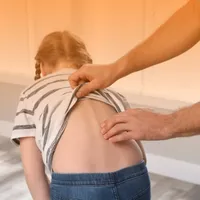
Common early signs include one shoulder sitting higher than the other, a prominent shoulder blade, an uneven waistline, the body leaning to one side, clothes hanging unevenly, and a rib hump that appears when your child bends forward (the Adam’s forward bend test). Scoliosis is usually painless in children, so visual signs — not complaints of pain — are what parents most often notice first.
Why is growth stage important?
Because curves progress fastest while the skeleton is growing. A clinician estimates growth remaining using signs of skeletal maturity (such as the Risser sign on X-ray), and this shapes both the risk of progression and the urgency of care. The same 25-degree curve carries a very different outlook in a 11-year-old before their growth spurt than in an 17-year-old who has nearly finished growing.
Can children benefit more from early intervention?
Generally, yes. A growing spine is more responsive, and smaller curves are easier to manage than larger ones. Starting scoliosis-specific care while a curve is still mild gives the widest range of options and uses remaining growth as an ally rather than a risk. Individual results still vary with curve type, compliance and biology — early care improves the odds, it does not remove the need for monitoring.
How frequently should a growing child be monitored?
During the growth years, reviews are commonly scheduled every 4–6 months, with the interval tightened during rapid growth spurts or if a curve is changing. At ScolioLife® the monitoring schedule is set individually, combining posture photos and scoliometer readings between X-rays so that radiation exposure is kept to a minimum.
Can children with scoliosis continue exercising and playing sports?
Yes — in almost all cases children with scoliosis should stay active, and sport is encouraged alongside scoliosis-specific care. Activity supports muscle strength, bone health and confidence. Your clinician may suggest adjustments for specific activities during an intensive correction phase, and can advise on your child’s particular sport at the consultation.
 Adult Scoliosis
It is never too late to understand your spine — but goals differ from adolescent care.
Is it too late to seek care as an adult?
No. Adults of any age can be assessed and cared for — the goals are simply different. Adult care focuses on reducing pain, improving posture and function, and supporting the spine against gradual progression, rather than on the large angle corrections that are sometimes possible during growth.
Can adult scoliosis cause pain, fatigue or balance problems?
Yes. While adolescent scoliosis is usually painless, adult scoliosis commonly causes back pain, muscle fatigue on one side, stiffness, and in some cases a sense of leaning or imbalance. Degenerative changes in discs and joints can add nerve-related symptoms such as leg pain. These symptoms are exactly what a thorough assessment is designed to untangle.
What can non-surgical care realistically achieve for adults?
Realistic goals for adults are symptom relief, better posture and mobility, stronger supporting muscles, and helping to stabilise the curve over time. Meaningful Cobb-angle change is less predictable in adults than in growing adolescents, and an honest programme distinguishes clearly between improving how the spine feels and functions, and changing the angle on an X-ray. Individual results vary with age, curve type and consistency.
Can adults wear a scoliosis brace?
Yes. Adults can be fitted with a custom brace such as the ScolioAlign® 3D brace, usually on a part-time schedule aimed at postural support, pain relief and unloading fatigued muscles — rather than the fuller-time growth-phase protocols used for teenagers. Suitability is assessed individually.
 Scoliosis Assessment and X-Rays
What happens at the first visit, and what imaging is needed.
What happens during the first consultation?
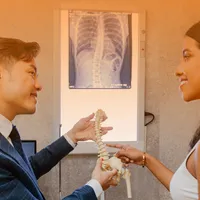
The first consultation at our Singapore clinic includes a full history, a physical and postural examination, scoliometer measurement of trunk rotation, a review of any X-rays you bring, and an unhurried discussion of findings and suitable options. A trial therapy session is included, so you experience the approach before committing to anything. Allow about 1 to 2 hours.
Do I need to bring an X-ray?
No — you can attend without one. An existing X-ray is helpful because it lets the team measure your Cobb angle on the spot, but if imaging is needed we will advise you where and how to obtain it after your initial assessment, so nothing is taken unnecessarily.
What type of X-ray is normally required?
A standing full-spine X-ray (posterior-anterior view, often with a side view) is the standard image for scoliosis, because the Cobb angle must be measured with the spine under normal upright load. Lying-down or partial-spine films are less useful for diagnosis and planning.
How recent should the X-ray be?
As a general guide, a film taken within the last 6 months is preferred for a growing child or teenager, and within the last 12 months for an adult, because curves can change meaningfully over these periods. Bring whatever you have — the team will confirm at the consultation whether your existing imaging is recent enough to plan from.
What does the clinician assess besides the Cobb angle?
The Cobb angle is only one number. A full assessment also looks at vertebral rotation, the overall curve pattern, skeletal maturity and growth remaining, posture and balance, trunk symmetry, muscle strength and flexibility, breathing mechanics, symptoms, and how your spine affects daily life. Together these shape a far more complete picture than the angle alone.
How often are follow-up X-rays required?
Typically every 6 to 12 months, depending on age, growth stage and how actively the curve is being managed. Between films, progress is tracked with posture photography, scoliometer readings and functional measures, which keeps radiation exposure as low as reasonably possible.
 ScolioLife® Treatment Programme
How the programme works, and what commitment it asks of you.
What is the ScolioLife® Method?
The ScolioLife® Method is an integrated, non-surgical programme that combines scoliosis-specific corrective exercise, custom 3D bracing with the ScolioAlign® brace where indicated, nutritional support for bone and muscle health, and structured monitoring. Developed by Dr Kevin Lau over more than 20 years, it addresses the curve in all three planes rather than treating the spine as a simple sideways bend.
Is the programme the same as general physiotherapy?
No. General physiotherapy strengthens and mobilises the body symmetrically, which is valuable for many conditions but does not address the asymmetric, rotated nature of a scoliotic spine. Scoliosis-specific exercise — including Schroth-based methods — trains corrective movements and breathing patterns matched to your individual curve pattern, in the opposite direction of the curve’s collapse.
Is the programme customised for each patient?
Yes. Every programme is built around your curve pattern, age, skeletal maturity, symptoms and goals. A 13-year-old with a growing 30-degree thoracic curve, and a 50-year-old with a painful degenerative lumbar curve, will follow very different plans even though both are ScolioLife® patients.
How often are treatment sessions scheduled?
In-clinic sessions are usually weekly, with programmes commonly ranging from 12 to 48 sessions depending on curve severity and goals. Session frequency is reviewed as you progress, and intensive daily formats are available for patients travelling from overseas.
Are home exercises required?
Yes — daily home exercise, typically 15 to 30 minutes, is a core part of the programme rather than an optional extra. Clinic sessions teach and refine your corrective movements; daily practice is what turns them into your spine’s new normal. Consistency at home is one of the strongest factors in how well patients do.
How long does a programme usually last?
Most active programmes run from several months to about a year, with postural improvements often visible within the first months and X-ray comparison typically made at 6 to 12 months. After the active phase, a lighter maintenance routine protects the result — especially for adolescents until growth is complete.
Are results guaranteed?
No — and no responsible provider should guarantee outcomes for scoliosis. Results depend on age, skeletal maturity, curve type and size, brace-wear consistency, exercise adherence and individual biology. What we can promise is an honest assessment, a clearly explained plan, and objective measurement of progress at every stage. You can review documented patient outcomes on our results page.
 The ScolioAlign® 3D Brace
How the brace is made, worn, and reviewed.
What is the ScolioAlign® 3D Brace?
The ScolioAlign® brace is a custom-made corrective brace designed from a 3D scan of your torso using CAD/CAM technology. Its over-corrective design aims to guide the spine toward a corrected, de-rotated position while worn — a different philosophy from traditional symmetric hospital braces, which mainly aim to hold a curve where it is.
How is the brace customised?
Design starts with a 3D body scan and your standing X-ray. The corrective shape is modelled digitally for your specific curve pattern, manufactured with CAD/CAM precision, then fitted and fine-tuned in person. An in-brace X-ray verifies the correction the brace actually achieves, and adjustments are made from there.
How many hours per day may the brace need to be worn?
Wear time is prescribed individually. For growing adolescents on a full-time protocol this is commonly 18 to 23 hours per day; part-time or night-time schedules may be appropriate for smaller curves, near-mature teens, or adults wearing a brace for support. Research consistently links actual hours worn to results, which is why compliance is monitored and supported rather than assumed.
Is the brace uncomfortable at first?
There is an adjustment period — most patients need one to two weeks to build up to full wear time. You should feel firm corrective pressure, not pain. The ScolioAlign® brace’s lightweight construction and ventilation are designed for Singapore’s climate, and any persistent discomfort is resolved with an adjustment rather than endured.
Can the brace be worn at school?
Yes. The brace is slim enough to wear under a loose school uniform, and many students wear it through the school day without classmates noticing. The care team can advise on clothing choices and on a note for the school where helpful.
Can it be removed for sports and bathing?
Yes. The brace comes off for bathing, swimming, sports and scoliosis-specific exercise sessions, within the daily out-of-brace allowance in your prescription. Sport and brace wear are complementary: one builds active muscular control, the other provides corrective input for the remaining hours.
Why is an in-brace X-ray important?
Because it is the only objective way to confirm the brace is doing its job. The in-brace film shows how much the curve corrects while the brace is worn — the single best early indicator of how effective bracing is likely to be. If in-brace correction is inadequate, the brace is adjusted or remade rather than simply worn and hoped for.
How frequently must the brace be reviewed or adjusted?
Regularly — especially in growing patients, where reviews are typically scheduled every few months and after any noticeable growth spurt, since a brace that fit perfectly six months ago may no longer deliver the same correction. Adults on supportive protocols generally need less frequent reviews. Your review schedule is set at fitting and refined as you progress.
 Appointments and Fees
Booking, consultation length, and how fees are worked out.
How long does the first appointment take?
Allow about 1 to 2 hours. This covers the full assessment, X-ray review, discussion of findings, and your trial therapy session — enough time to have every question answered without feeling rushed.
Is a trial therapy session included?
Yes. The first consultation includes a trial session of scoliosis-specific therapy, so you or your child can experience the approach first-hand before deciding on a programme.
How can I book an appointment?
The fastest ways are online booking or WhatsApp at +65 8907 8900. You can also call the clinic at +65 6635 2550, email clinic.sg@scoliolife.com, or use the contact page. Appointments are usually available within a few days.
How are treatment fees determined?
The first consultation in Singapore is SGD 180 before GST, including the assessment, posture analysis and trial session. Programme fees depend on what your spine actually needs — curve severity, whether bracing is indicated, and programme length — so a complete, itemised quote is provided after your assessment, with no obligation to proceed.
Are weekend appointments available?
Yes — the Singapore clinic opens Saturday mornings (9:00 am to 1:00 pm) in addition to weekdays (10:00 am to 6:00 pm). Saturday slots are limited and in high demand, so book ahead where possible. The clinic is closed on Sundays.
 Overseas and International Patients
Travelling to Singapore for care, and staying supported after you fly home.
Does ScolioLife® accept overseas patients?
Yes. Patients travel to our Singapore clinic from more than 50 countries across Asia, Oceania, Europe, the Americas and Africa. Indian patients fly from Chennai, Mumbai, Delhi, Bengaluru and Hyderabad to Singapore in about 4 to 5 hours. Our global patients page explains the full overseas journey, from first contact to follow-up after you return home.
Is an online consultation available before travelling?
Yes. A Zoom teleconsultation lets you discuss your case with the team before booking flights, and a digital X-ray review can assess your imaging remotely — so you arrive knowing your visit is worthwhile and what it will involve.
Are intensive programmes available?
Yes. Overseas patients typically follow a condensed intensive format — for example a 5-day programme with several hours of therapy each day — designed to deliver assessment, training and, where indicated, brace scanning and fitting within a single trip. Brace manufacture is prioritised so fitting can happen before you fly home.
How do follow-ups work after I return home?
Through scheduled teleconsultations and remote monitoring: you send posture photos, scoliometer readings and periodic X-rays taken locally, and the team reviews progress and adjusts your home programme. Many international patients combine annual or twice-yearly visits with remote reviews in between.
Get Answers Specific to Your Spine
Every scoliosis curve is different. A professional assessment can help you understand the curve pattern, progression risk and care options that may be suitable for you or your child.
The information on this page is educational and general in nature. It is not medical advice and does not replace an individual clinical assessment. Outcomes of scoliosis care vary with age, skeletal maturity, curve type and severity, treatment suitability, brace-wear and exercise consistency, and individual factors. Severe, rapidly progressing or neurologically symptomatic curves should also be evaluated by an appropriate medical or surgical specialist.