Vacuum Bell System
Reclaim Your Confidence: Non-Surgical Pectus Excavatum Correction
The ScolioLife® Vacuum Bell System
The ScolioLife® Vacuum Bell is a non-surgical way to lift a sunken chest at home. It is an established, non-invasive option for mild to moderate pectus excavatum — professionally guided by Dr Kevin Lau, and among the few clinics in Southeast Asia to offer this home-therapy programme.

Are you or your child struggling with the physical and emotional impact of a sunken chest? At ScolioLife®, we believe correction should not have to mean invasive surgery, painful recovery, or lengthy hospital stays. Our professionally guided Vacuum Bell therapy is designed to help you work toward a flatter, more symmetrical chest from the comfort of your own home.
What Is Pectus Excavatum?
Pectus excavatum is a congenital chest-wall condition where the breastbone (sternum) grows inward, creating a hollow or “sunken” chest. It is the most common chest-wall difference, affecting roughly 1 in 300 to 400 people, and often becomes more noticeable during the adolescent growth spurt.
Beyond appearance, a sunken chest can affect:
 Posture and alignment — the inward sternum can pull the shoulders forward and round the upper back.
- Breathing mechanics and endurance — reduced chest capacity can limit stamina during exercise.
- Self-confidence and body image — many patients avoid swimming, sports or social situations.
- Physical performance — in sports and everyday activity.
How Negative Pressure Improves Chest Capacity
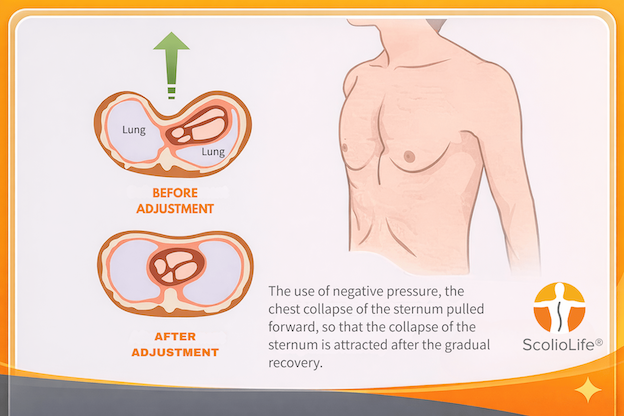
How Does the ScolioLife® Vacuum Bell Work?
The Vacuum Bell is a medical-grade suction device that gently lifts the depressed chest wall using controlled negative pressure. Applied a little each day, the suction encourages gradual remodelling of the sternum and rib cage, drawing the chest outward toward a flatter contour over months of consistent use.
Why patients choose the ScolioLife® Vacuum Bell:
- Completely non-invasive — no surgery, no scars, no hospital stays.
- Convenient home use — perform your daily therapy in private.
- Professionally guided — backed by the clinical expertise of Dr Kevin Lau.
- Synergistic results — complements your existing body-rehabilitation programme.
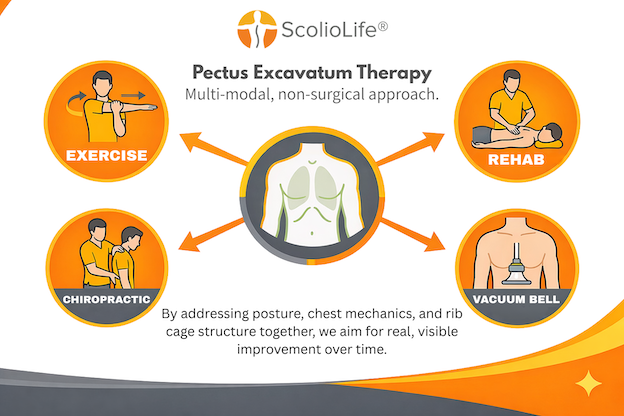
Our Multi-Modal, Non-Surgical Approach
Superior Build: Designed for Comfort, Durability and Safety
We do not compromise on quality. Every ScolioLife® Vacuum Bell is engineered to a high medical standard so daily therapy is both effective and comfortable.
- Medical-grade hypoallergenic silicone — the soft ring contours to the chest for an airtight seal without skin irritation.
- Shatter-resistant polycarbonate window — watch the sternum rise so you apply the right amount of pressure safely.
- Precision hand pump with safety release — full control of vacuum pressure, with an instant-release valve for safe removal.
- Engineered for longevity — built to withstand years of daily use.
Vacuum Bell vs Surgical Correction: How They Compare
For mild-to-moderate, flexible chest walls, the Vacuum Bell offers a non-surgical alternative to operations such as the Nuss procedure. The table below compares the two approaches.
| ScolioLife® Vacuum Bell | Surgical Correction (Nuss) | |
|---|---|---|
| Invasiveness | Non-invasive, no incisions | Surgery under general anaesthesia |
| Hospital stay | None — used at home | Hospital admission required |
| Scarring | None | Surgical scars |
| Best suited for | Mild-to-moderate, flexible chest walls | Severe or rigid deformities |
| Timeframe | Gradual, over months to years of daily use | Metal bar implanted ~2–3 years, then removed surgically |
| Recovery | No downtime | Weeks of post-operative recovery |
| Supervision | Guided by Dr Kevin Lau | Performed by a surgical team |
Unlock Maximum Results: The Complete Non-Surgical Programme
The Vacuum Bell System works well on its own, but achieves its best results when combined with our Pectus Excavatum Non-Surgical Correction Programme.
“A structural problem requires a comprehensive solution. By pairing the mechanical lift of the Vacuum Bell with targeted exercises, physiotherapy and chiropractic care, we strengthen the surrounding muscles and correct postural imbalances — helping the sternum hold its improved position.” — Dr Kevin Lau
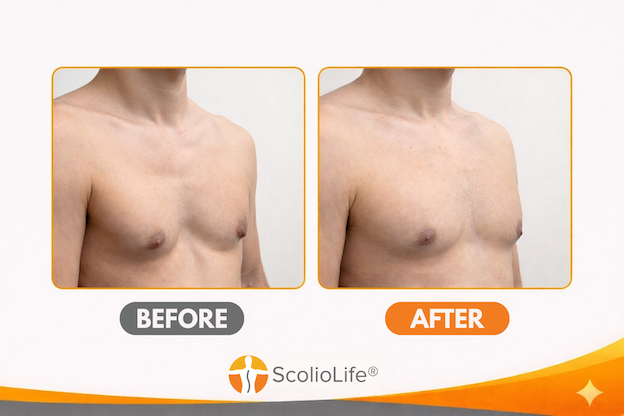
Results After the Program
How to Use the Vacuum Bell System
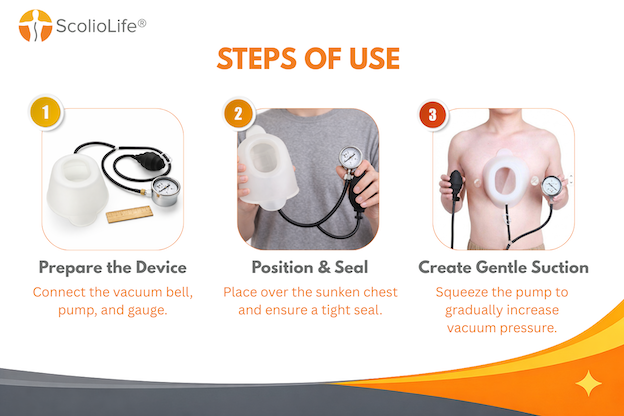
Used consistently each day, the Vacuum Bell is simple and safe to apply at home. Below is the daily protocol for maximum efficacy:
- 1. Preparation — ensure the chest is clean and dry. For patients with chest hair, shaving the area helps maintain an airtight seal.
- 2. Placement — centre the viewing window directly over the deepest point of the sunken chest.
- 3. Apply pressure — press the bell firmly and squeeze the hand pump slowly until a comfortable lift is achieved. Do not over-pump.
- 4. Duration of wear — wear as prescribed by Dr Lau. Standard protocols typically begin at 30 minutes, 1–2 times daily, increasing as tolerated.
- 5. Safe removal — open the release valve to relieve the pressure, then gently lift the bell away from the skin.
- 6. Cleaning — wipe the silicone seal with warm water and mild soap after each use to maintain hygiene and device life.
Steps of Using the Vacuum Bell
Who Is It For?
The Vacuum Bell System is best suited to people with mild to moderate pectus excavatum and flexible chest walls.
- Children and adolescents — excellent for early intervention before the bones fully harden.
- Teenagers — ideal during active growth years when the chest wall is most adaptable.
- Selected adults — effective for mild-to-moderate depression seeking cosmetic and functional improvement.
- Committed individuals — willing to follow daily use consistently for months to years.
Important Expectations and Safety
Results vary with age, chest flexibility and consistency of use. Cosmetic improvement is often significant, though it may not equal full structural correction in severe, rigid cases. Individual results vary.
Contraindications — the Vacuum Bell is not suitable for individuals with:
- Bleeding disorders, fragile skin, or open chest wounds.
- Recent chest surgery.
- Heart or lung disease, without explicit medical clearance.
- Children under 6, without strict parental supervision.
Frequently Asked Questions
Does the vacuum bell really work for pectus excavatum?
For mild-to-moderate cases with a flexible chest wall, the vacuum bell can produce meaningful cosmetic improvement when used consistently. Results are greatest in children and teenagers whose chest walls are still adaptable, and depend heavily on daily use over months to years. Severe, rigid cases may not fully correct and can require a surgical opinion. Individual results vary.
How long do you need to wear the vacuum bell each day?
Standard protocols typically start at around 30 minutes, one to two times a day, and gradually increase as tolerated. Dr Kevin Lau sets your exact schedule based on your age, chest flexibility and progress.
Is the vacuum bell painful or safe to use?
Most users feel only a firm suction sensation, not pain. A safety-release valve lets you remove the device instantly. It is not suitable for people with bleeding disorders, fragile skin, open chest wounds, recent chest surgery, or heart or lung disease without medical clearance.
What age is best to start vacuum bell therapy?
Earlier is generally better. Children and adolescents respond best because their chest walls are most flexible during growth, but selected adults with mild-to-moderate, flexible deformities can also benefit.
Can the vacuum bell replace surgery for a sunken chest?
For mild-to-moderate, flexible chest walls it offers a non-surgical alternative to procedures such as the Nuss operation. Severe or rigid cases may still need a surgical referral. A ScolioLife assessment helps determine which path suits you.